

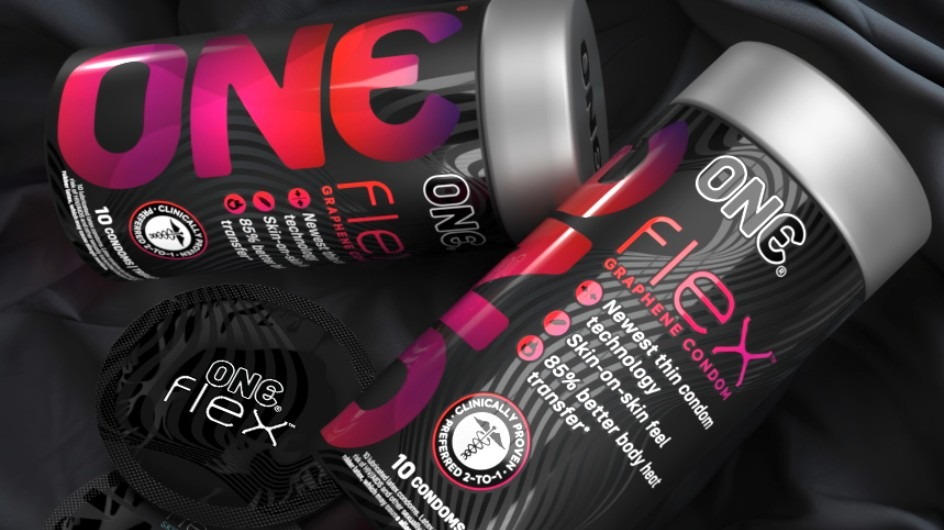
Ten testers across Denmark and Spain put the world's first graphene-enhanced condom through standard, slow-connected, and high-intensity sessions. The verdict: ONE Flex genuinely delivers on its promise of warmer, thinner, more skin-like sex, but a couple of breakage incidents and a polarizing tube package keep it from being a universal slam dunk.

Our scale: Exceptional, Good, Acceptable, Poor. Good is a strong result. Exceptional is rare.
There is a particular moment that keeps surfacing in these tester transcripts, and it tells you almost everything you need to know about the ONE Flex condom. A couple, mid-session, pauses for a second and wonders out loud whether the condom is actually still on. They check. It is. They keep going. It is the kind of small interruption that, in any other context, would be a minor red flag. Here, it is the highest compliment a thin condom can receive: the wearer and their partner have, briefly, forgotten there is a barrier between them at all.
That moment, in slightly different forms, repeats across more than half of our testers' reviews. It is also exactly what graphene is supposed to do in this product, and largely, what our testers experienced. But the picture is not uniformly rosy. Two testers had it break on them, a few took issue with a tube-style outer packaging that one tester compared to engine oil branding, and one tester pointed out that "thin condom that feels like skin" is, in fact, an entire category now, which raises the fair question of how revolutionary any single entry can really be.
So let's get into it.

ONE Flex is the world's first graphene-enhanced condom, the product of nearly a decade of research and development by ONE Condoms. The technical hook is that graphene, a single-atom-thick lattice of carbon, has been molecularly bonded with natural rubber latex, and that hybrid material does three things at once.
First, thinness. Graphene is roughly a million times thinner than a human hair, and bonding it into the latex lets ONE produce one of the thinnest condoms on the market without the usual structural compromises. Second, strength. Graphene is cited as 200 times stronger than steel, and the molecular bond is meant to keep that ultra-thin profile from translating into fragility, while also letting the latex stretch further without feeling tighter. That directly targets the most common complaint about ultra-thin condoms, which is that they squeeze. Third, heat transfer. Latex on its own is a thermal insulator, which is why standard condoms feel cool and muffle a partner's body heat. Graphene is the most thermally conductive solid ever discovered, and the hybrid material reportedly increases body heat transfer by 85 percent compared to standard latex condoms.
In our testing, the Flex was compared against two unbranded reference condoms, called standard A and standard B in the survey data. So when testers describe differences, those comparisons are direct and same-session, not vague memory.
A small but recurring detail: testers said the material felt different even before sex began, when handling it between their fingers. One Male, 40, DK tester put it well, noting that the material does not feel like the typical rubbery latex but more skin-like to the touch. Given the molecular bonding of graphene into the latex, there is at least a plausible structural reason behind that, and the difference is detectable outside the bedroom too.
The single most consistent theme across our testers is heat transfer. Almost everyone who used the Flex said it felt warmer, faster, and more like skin contact than what they were used to. This is exactly where the graphene story should pay off, and on this dimension, our testers' experiences track the manufacturer's claims closely. For couples who use condoms regularly (and several of our testers do, often as their primary method of contraception), this matters. The thermal disconnect of a standard condom, that brief but real chill on entry, the muffled feeling of warmth being held back by latex, is one of the main reasons people complain about condoms in the first place.
"My partner said the warmth and sensitivity were much better than with regular condoms, almost like not wearing one. I could feel the difference when putting it on because it's so thin and sits neatly along the shape. It stayed on the whole time without slipping, the glide felt comfortable, and it simply felt safe."
The wearer-side benefit is more clearly documented than the receiving-partner-side benefit, which is worth being honest about. Several testers with vaginas noted that the warmth difference was much more vivid for the partner wearing the condom than for them. Female, 24, DK was admirably blunt about this, observing that whether or not warmth could be felt internally was not really how her nerve endings worked, and that for her partner, the temperature difference was the most noticeable thing. This is a useful corrective to marketing language that suggests both parties will experience an equal sensory upgrade. They probably will not, and that is fine, as long as expectations are calibrated. The 85 percent figure refers to heat transfer through the condom itself, not to how that heat is perceived on the receiving end, which depends entirely on individual anatomy and nerve distribution.
For wearers, though, the gains are more universal. Male, 38, DK described it as more feeling for both of them, especially warmth, and said that as a couple who uses condoms often because his partner is not on hormonal contraception, finding something that genuinely improves the experience is meaningful. Male, 54, DK called it clearly better than standard condoms, although he refused to call it a revolution, which feels like the right register. Male, 50, DK, who included anal sex in his testing, was particularly struck that it stayed put under conditions where he often finds condoms get pulled or worked loose.

A small but interesting wrinkle in the feedback: a number of testers commented that the Flex sits looser than they expected, in a good way. Non-binary, 25, DK described many condoms as feeling tight, almost cock-ring-like, and praised the Flex specifically for not doing that. Several other testers echoed this: the Flex hugs the shape rather than squeezing it. This is consistent with the material claim that graphene-bonded latex stretches further without increasing perceived tightness, although our testers obviously cannot verify the molecular mechanism, only the outcome.
The stability story is mostly positive. Across nearly all sessions where the condom did not break (we will get to breakage), testers reported that it stayed in place without needing to be pulled down or repositioned mid-session. Male, 29, DK noted that he and his partner did not have to adjust it, which sounds like a small thing until you have spent time with condoms that require constant management. Male, 50, DK, testing in anal sex contexts, was especially appreciative that the condom did not migrate, which is a known weak spot for thin condoms in that use case.
"I liked how it felt looser than many condoms that sit very tight and can feel a bit like a cock ring. We rarely needed to adjust it, and it felt secure the whole time. Slower sex felt especially good because we both got more sensation, and overall it was comfortable and reliable."
There is a minor but worth-noting detail about pacing: Non-binary, 25, DK and at least one other tester said the Flex felt best during slower, more connected sex than during high-intensity sessions. The reasoning offered was that slower pacing gave both people more time to register the sensitivity gains, while at higher speeds, the difference flattened out. This is not a flaw exactly, but it is a useful framing: if you are buying a condom specifically because you are doing slow, intimate, drawn-out sex, the Flex is well-suited to that. If you are after something for short, fast, intense sessions, the sensory uplift may be less pronounced.
Two of our ten testers reported the condom breaking, and that is worth flagging honestly. A sample of ten is far too small to draw statistical conclusions about the Flex's actual breakage rate (that would require a much larger, controlled study), but it is still striking that two testers in our group ran into this issue.
Female, 24, DK had it break on first use, with no clear reason why. She was more cautious afterward and added lube per the included instructions, but the extra lube then reduced friction so much that her partner could not feel anything. Female, 26, DK also had a break on first use, and said it undermined her trust enough that she would not reach for the Flex again as her primary option. Both testers mentioned that the strength claims around graphene had raised their expectations, which made the failure feel sharper.
The other eight testers reported zero incidents across multiple sessions, including high-intensity and anal scenarios. Male, 50, DK was particularly emphatic that anal sex did not cause any pulling or slipping at all. So the picture is mixed: most users had a clean experience, two did not.
If you are someone for whom a single condom failure is unacceptable risk, the two-out-of-ten figure from our small test group is worth keeping in mind. If you treat condoms as a layered method alongside another form of contraception or STI testing, it is less alarming. Either way, a larger study would be needed to know whether the Flex's breakage rate genuinely differs from standard condoms.
Connected to the reliability question is a lubrication trade-off that several testers flagged. With minimal lube, the Flex glides well for some couples and gets sticky or break-prone for others. With added lube, breakage risk drops, but so does the sensitivity benefit that justified buying the Flex in the first place. Female, 24, DK ran headlong into this: adding lube to prevent breakage made things so slick that her partner stopped feeling much at all, which negated the whole point.
This is not unique to the Flex (it is a problem with thin condoms generally), but it is more pronounced here because the sensory promise is more aggressive. Couples who naturally produce a lot of lubrication may need to add little or none, and may get the full benefit. Couples who tend to need lube anyway will be doing a slightly more delicate balancing act between protection and sensation.

The Flex's packaging is doing two contradictory things at once. The individual condom wrapper, a round foil rather than the standard rectangular square, was almost universally praised. Testers said it was easy to open, easy to handle, and easier to roll the condom on from. Male, 40, DK and Male, 54, DK both flagged this as a quietly impressive design choice.
The outer tube, on the other hand, took a beating. The tube is made from 100 percent recycled paper, which is genuinely admirable as a sustainability decision. The execution, however, divided testers. Female, 24, DK was the most direct critic: she found the tube bulky, dark, and not at all discreet, with what she perceived as a lot of wasted internal space, and absolutely not something she would want to be seen buying or carrying. Male, 40, DK echoed the criticism from a different angle, calling the design too aggressively masculine in a way that felt dated, more like packaging for engine oil than for an intimate product. His specific suggestion was that more neutral, inviting packaging would broaden the audience considerably, and that observation feels right. The product is good. The packaging may be telegraphing that it is exclusively for a very particular kind of straight cis man, and that is leaving sensation, comfort, and inclusion on the table for everyone else.
The ONE Flex is most likely to delight you if you are a couple already using condoms regularly and frustrated by the standard options' thermal and sensory dullness, particularly the partner wearing the condom. It is worth trying if you have found other thin or invisible-feel condoms too tight or restrictive, since the graphene-latex hybrid does seem to deliver on the "stretches without squeezing" promise. It is genuinely good for slower, more connected sex, and it appears to perform well in anal contexts based on Male, 50, DK's testing.
It is probably not the right pick if you have had condom breakage trauma in the past and need maximum confidence in a barrier method, or if you are someone for whom packaging discretion matters (carrying the tube around in a bag is, by Female, 24, DK's account, not subtle). It is also probably not transformative enough to justify a significant price premium over other thin condoms already on the market, as Male, 54, DK and Non-binary, 25, DK both pointed out. The category exists, the Flex sits comfortably within it, and where you land on cost-versus-feature will depend on what is in your nightstand drawer right now.
Strip out the marketing language and what you have is a thin condom with a genuinely novel material story behind it, delivering a real, perceptible improvement in warmth transfer and sensitivity, with a fit that more testers found pleasant than constraining, and a primary wrapper design that is genuinely better than the industry standard. That is a meaningful product. It is not a revolution, and it has a reliability question mark that prospective buyers should weigh honestly. But the moment when a couple has to pause and double-check whether the condom is still on, that moment is real, and several of our testers experienced it. For a thin condom, that is the prize, and the Flex hits it more often than it misses.


